Showing posts with label st patricks day. Show all posts

Saturday, March 12, 2011

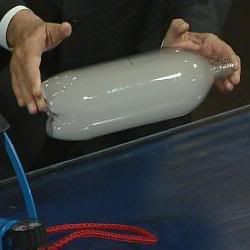
Lucky Science: Cloud in a Bottle

March may come in "like a lion" but this is one cloud that won't dampen your spirits (or your clothes!)


Cloud in a Bottle

What you need:
  • One liter clear plastic bottle + cap
  • Foot pump with rubber stopper attached
  • Rubbing alcohol
  • Safety glasses
While wearing safety glasses, put just enough rubbing alcohol in the bottle to cover the bottom and swirl it around. Put the rubber stopper on. Pump the foot pump 5 times being sure to hold the stopper tight to the bottle. Then pull out the stopper and you will see a faint "poof" of a cloud. If it's very faint, that means there wasn't enough pressure. Repeat the experiment pumping 10 times this time, still holding the stopper tight to the bottle. This time the cloud should be more visible but you may wish to repeat again with 15-20 pumps, still holding the stopper tight to the bottle. Then after removing the stopper you should see a good cloud.

What's happening?

By pumping the bottle with pressure, you are forcing the water molecules to compress. When the pressure is released, the molecules expand and cool the air. The cooler air allows the molecules to condense and form tiny water droplets. 

You can watch Steve Spangler do the experiment and explain it on this video and you can read about the experiment here


Pin It

Thursday, March 10, 2011

Lucky Science: Potatoes

Few things are as synonymous with Ireland as the potato. They're a staple in most kitchens and they can also be a great learning tool.

What you need:
  • Potato (the older the better). Look for one that's already started sprouting or has several eyes (bumps that show where the potato is about to sprout).
  • 4 toothpicks
  • Wide-mouthed watertight container. (Choose a clear glass jar so your children can spot the first rootlets growing.)
Sometimes potatoes from the supermarket have been sprayed with a substance to keep them from sprouting. Scrub your potato well to make sure it will sprout.

Stick four toothpicks around the middle of the potato. The toothpicks should be placed equal distance around the potato, like the spikes of a bicycle wheel. The toothpicks will act as the supports you need to suspend the potato on the rim of the jar.

Fill the jar with enough water so that the bottom third of the potato is submerged. There need to be some eyes beneath the water.

photo source

Place the jar in a sunny spot and wait.

As days pass, change or add water as needed. Don't let the water get cloudy.

In a few days, you'll notice white, stringy roots starting to grow from the bottom of the potato. In two or three weeks, stems and leaves will sprout from the top. Remember to keep the potato watered.

Potato sprouts grow quickly, but they're also fragile. Consider giving your vines a stake or trellis to climb.
photo source

Help your child observe and record the changes in the potato over time. Measure the length of the vines and count the number of leaves.

Move your potato to a larger jar if it becomes too big for its first home. After about a month, you can transfer it to a small pot and watch it grow even more.

A sweet potato has lovely purpley leaves and can be sprouted using the same method.

Caution: potatoes belong to the same family as nightshade and their leaves are poisonous. Keep young children well away from this experiment!


Pin It

Wednesday, March 9, 2011

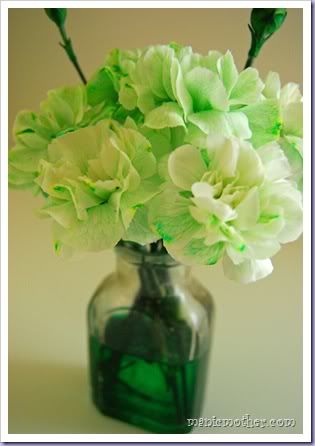
Lucky Science: Green Carnations

This experiment is a fun way to show where water goes when a plant is watered and by using green food coloring you will end up with fun green flowers for your St. Patrick's Day table.

Photo source

Green Carnations

What you need:
  • carnation
  • plastic cup
  • food coloring (green for this one, but you can use any color)
  • knife (an adult should use this)
  • water
Fill the plastic cup half way full with water and add 20-30 drops of food coloring. Have an adult make a fresh cut on the flower stem before placing the flower in the cup.

What's Happening:

Plants use their roots to "drink" water from soil. Even after a flower has been cut and no longer has roots, it uses its stem to suck up water for the flower and leaves. As water evaporates from the flowers and leaves, more water is sucked up through the stem, almost like a straw. The colored water doesn't hurt the flower, but allows us to see how the water moves through the plant.

You can read more about the experiment and ideas for further experimentation on Steve Spangler's website.

Pin It

Tuesday, March 8, 2011

Lucky Science: Irish Harp

Ireland is unique in having a musical instrument as its national emblem. You'll find the Irish harp adorning the coat of arms, seal, and on the Irish euro coin.


An Irish harp (or Clarsach if you're feeling Gaelic!) is distinguished by its triangular frame. Originally it was strung with brass wire, but modern versions generally use strings.


If you're not too particular about the shape, you can make your own harp and experiment with a little science in the process!

Here's what you need:
  • box, pan, or bin without a lid
  • three or more rubber bands of different thicknesses
Set up some boundaries for safely using rubber bands (you know the little darlings are just itching to flick them at someone!). Stretch the rubber bands across the open shoe box. Space them so they aren't touching.
photo credit: learningideas

Now strum or pluck the bands. Compare pitches of different rubber bands. Try pushing your finger on the end of a band to stretch it tighter. Then pluck the rubber band with your other hand. Listen for how the sound changes.

photo credit: unplug your kids

Ask questions about the sound that is produced from the fat rubber bands and the thin ones. How does the sound change when you increase the tension? Can you arrange the rubber bands so you can play a tune?

What is happening:

Tight rubber bands produce higher pitches.

Thin rubber bands produce higher pitches.

The longer and looser the rubber band, the lower the pitch.

Musical instruments, such as a harp, make sounds when the strings vibrate the air. Sound waves travel through the air like ripples across a pond. High sounds make waves that are close together. Low sounds make waves that are further apart.

Things that are tighter, shorter, thinner, and less dense make shorter sound waves (higher sounds). Things that are looser, longer, thicker, and denser make longer sound waves (lower sounds).


If rubber band harps strike a chord (pluck a chord?) with you, there are lots of different versions. You can use a speaker and go hi-tech.

source: sandoth.com

This book gives instructions for making your own Irish harp out of cardboard, wood, and string.

Your finished shoebox harp may not sound authentic, but with some help from kinderart.com, it can look more like the real deal.


Pin It

Monday, March 7, 2011

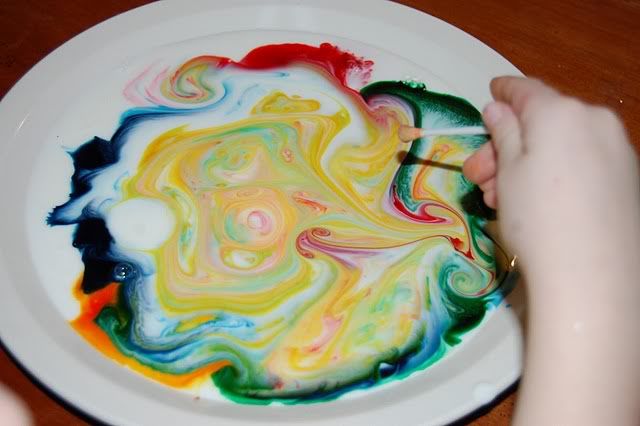
Lucky Science: Milk Magic

This week we're featuring some St. Patrick's day science experiments.

First up is the Milk Magic experiment featured on the lovely Kiasa's blog.


Milk Magic - Make Your Own Rainbow

Here's what you need:
  • whole milk
  • food coloring
  • liquid dish soap
  • q-tips
  • pie plate
Pour the milk into the pie plate just enough to completely cover the bottom.  Let it settle for a minute.  Put a drop (or two) of each color of food coloring into the milk, near the center (but not on top of each other).  Dip the end of your q-tip into the liquid dish soap and put that right into the center of the milk.  Hold it there and watch the magic.  Younger kids will want to stir it, but encourage them to just hold the q-tip in one place.  Or pick up the q-tip and place it in another part of the plate to see what happens.

What is happening:

The fat and protein molecules in the milk are very sensitive to change.  When you add the soap to the milk the molecules go crazy and move around.  By adding the food coloring we can actually see how these fats and proteins act when combined with soap.

Extreme experimentation:

What happens if you try it in water or low-fat milk?
Kiasa, thank you for sharing this experiment with us!

Pin It